Water shapes every farm, garden, and community landscape, yet we rarely treat it with the subtlety it deserves. Managing water well means stretching every drop where it matters most—into roots, not runoff; into storage, not waste. This article walks through practical methods and design principles that deliver real savings, improved yields, and stronger resilience to drought and storms.
Содержание
Why efficient water use matters now
Freshwater is a finite resource under mounting pressure from climate variability, population growth, and shifting land use. Agriculture consumes roughly 70 percent of global freshwater withdrawals, making every irrigation decision a leverage point for sustainability.
Beyond quantity, timing and quality matter: poorly timed water can boost disease pressure or leach nutrients, while runoff carries sediment and fertilizer into streams. Efficient water practices reduce these environmental impacts while protecting productivity.
Core principles of efficient water management
At its heart, efficient water management is about matching supply to plant needs with minimal loss. That requires understanding three variables: how much water the crop needs, how much the soil can hold, and how effectively your irrigation method delivers water to roots.
Another key principle is prioritization. Use the highest-quality, most reliable water where returns are greatest—nurseries, young plants, high-value crops—and fit lower-quality or seasonal supplies to tolerant uses such as pasture or landscape watering.
Finally, think in cycles: capture, store, apply, and conserve. Rainwater capture and on-farm storage reduce dependence on distant sources, while conservation strategies like mulching and soil-building improve retention between irrigations.
Overview of irrigation methods
Irrigation methods differ in efficiency, cost, and suitability for various crops and terrains. Choosing the right method begins with site assessment: soil texture, slope, water source, and labor availability all influence which system will perform best.
Here is a concise comparison to help orient decisions across common systems:
Surface methods move water across the field by gravity. They are simple and low-cost but demand careful land leveling and good water control to avoid deep percolation or uneven wetting.
Improvements such as laser leveling, surge irrigation, and cutback furrows can dramatically increase uniformity and reduce water use compared with traditional flood approaches. These upgrades often make sense where pumping costs are low and labor is available.
Sprinkler irrigation
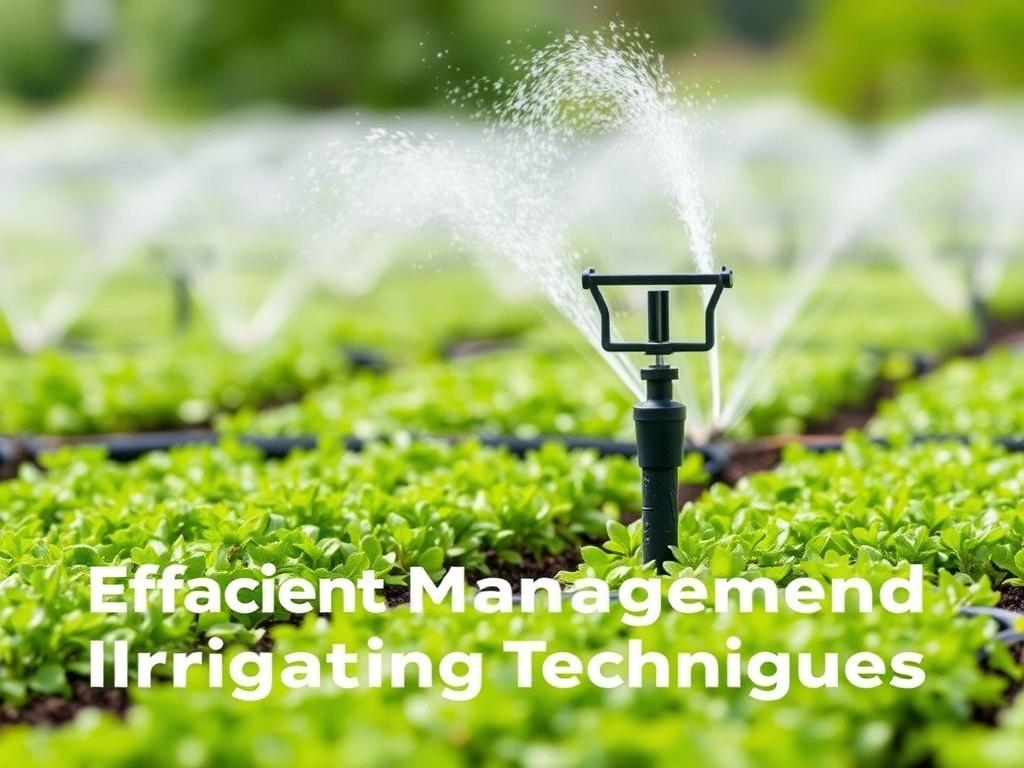
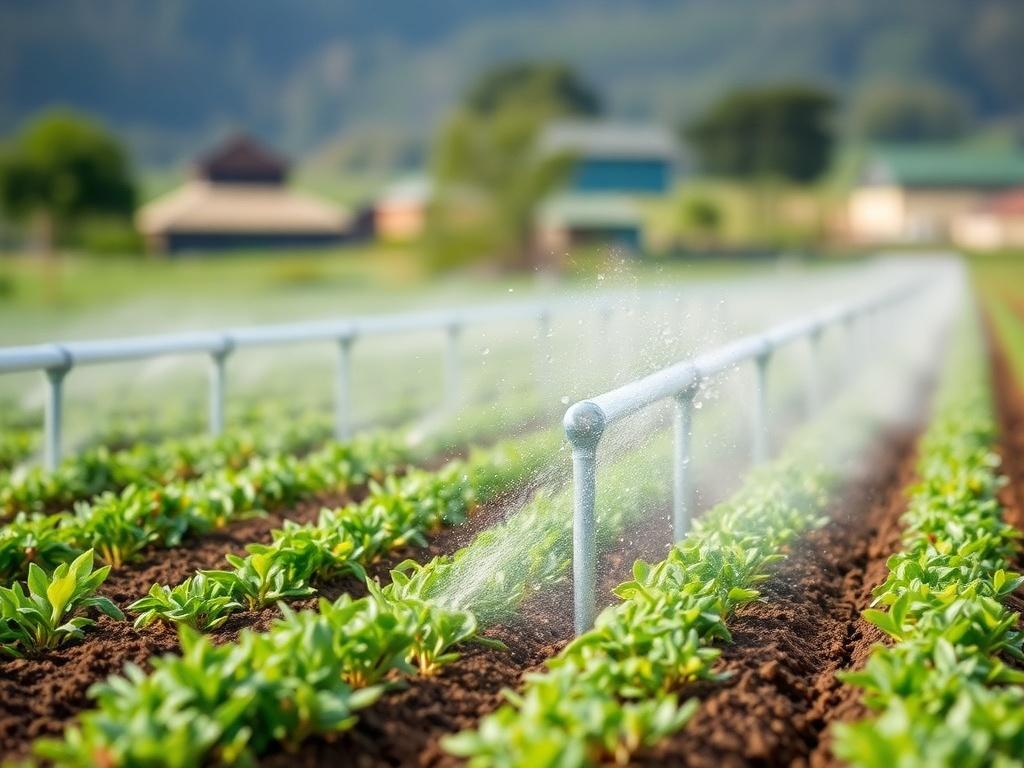
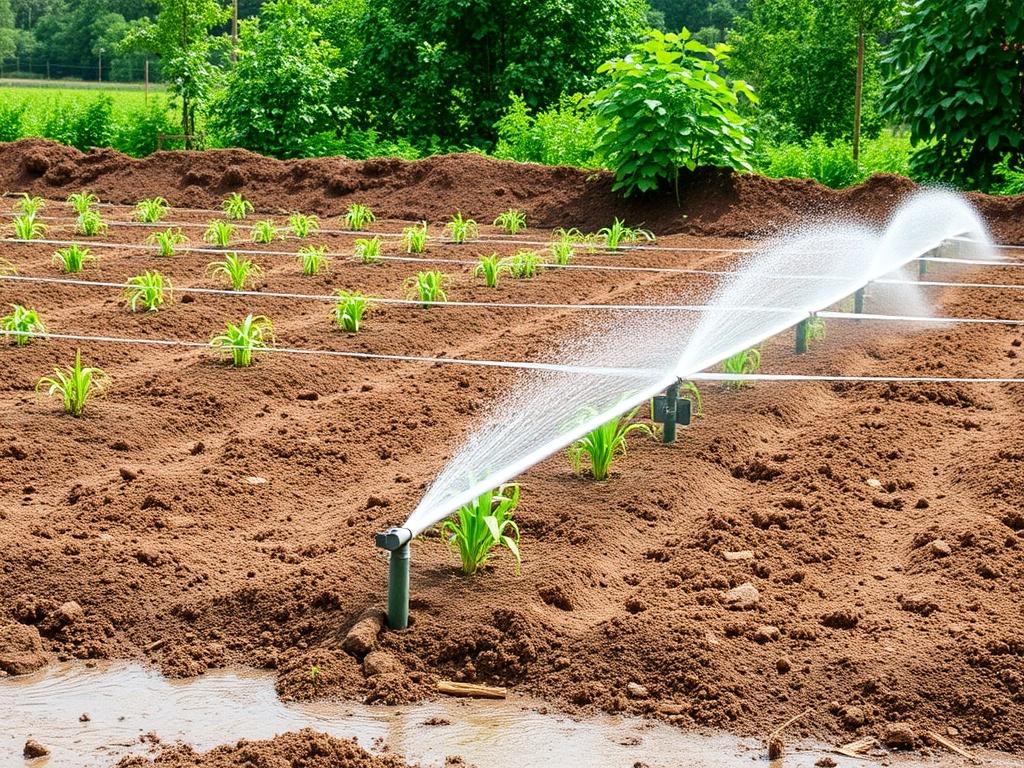
Sprinklers apply water through pressurized nozzles, mimicking rainfall. They can suit a wide range of crops and topographies and are adaptable to automation, but they lose water to wind drift and evaporation during hot, dry spells.
Design choices—nozzle size, operating pressure, and layout—affect distribution uniformity. For seasonal crops, portable or solid-set systems provide flexibility; for larger, uniform fields, center-pivot or lateral-move machines can be cost effective.
Drip and micro-irrigation
Drip systems deliver small amounts of water directly to the root zone through emitters or tubing. Their control and efficiency make them the gold standard where water is scarce or crops are high-value.
Drip reduces evaporation and foliage wetting, improving water use and disease management. The main barriers are initial cost and the need for filtration and maintenance to prevent clogging, but long-term water and nutrient savings often offset those costs.
Subsurface drip irrigation (SDI)
SDI places emitters below the soil surface where water loss to evaporation is negligible. This enhances water distribution uniformity and reduces weed growth, while enabling timely irrigation without interrupting field operations.
Installation is more complex and emitters must withstand soil pressures and root intrusion. For perennial crops and high-value irrigated row crops, though, SDI can be a strong investment with consistent long-term returns.
Advanced technologies that boost performance
Technology now lets managers measure plant stress, soil moisture, and local weather in real time—and then automate irrigation decisions. Sensors, controllers, and cloud-based analytics convert data into water savings.
Soil moisture probes and capacitance sensors avoid guesswork by telling you when to irrigate and how much water the root zone actually contains. Paired with weather-based controllers or evapotranspiration (ET) models, these tools can reduce unnecessary applications.
Remote sensing from drones or satellites adds another layer, detecting spatial variability across fields so you can irrigate different zones to different needs. This variable-rate irrigation approach reduces waste and increases yield uniformity.
Smart controllers and IoT
Smart controllers integrate weather forecasts, soil moisture readings, and crop stage data to schedule irrigation automatically. Many are cloud-connected, giving managers remote access to system status and alerts.
IoT-enabled valves and meters extend this connectivity across entire systems, enabling fault detection, leak alerts, and usage tracking. These capabilities save labor and let you respond quickly to issues that would otherwise waste water.
Remote sensing and mapping
Normalized Difference Vegetation Index (NDVI) and other satellite-derived indices reveal plant vigor and stress across large areas. Farmers can use these maps to identify under-irrigated zones or diagnose disease before it spreads widely.
For spot checks, drones provide high-resolution imagery and thermal maps that pinpoint seepage, clogged lines, or uneven distribution. Combining these tools with ground sensors provides a robust picture of system performance.
Scheduling irrigation: timing, amount, and methods
Irrigation scheduling is where science meets habit. The objective is simple: apply only what the crop needs at the right growth stages, and avoid waterlogging or stress that reduces yield or quality.
Evapotranspiration (ET) is the foundation for scheduling. ET estimates how much water a well-watered reference crop loses to evaporation and plant transpiration; adjusting ET with crop coefficients gives crop-specific water demand.
Using soil moisture to guide irrigation
Soil moisture thresholds tell you when to start and stop irrigation to maintain roots in the optimal moisture window. Sandy soils require more frequent, smaller events, while clay holds water longer but must avoid saturation.
Scheduling around soil available water and depletion thresholds prevents over-irrigation and helps time nutrient applications that move with water through the soil profile.
Consider crop growth stages
Crops have critical stages—flowering, fruit set, and early grain fill—when water stress causes disproportionate yield losses. Targeting irrigation to protect these windows is more efficient than maintaining high soil moisture throughout the season.
For perennial plantings, regular light irrigations can support steady growth, while seasonal crops often benefit from deficit irrigation strategies that save water with modest yield tradeoffs when timed correctly.
Soil and landscape practices that conserve water
Soil is the reservoir beneath your feet. Increasing its organic matter and improving structure trap more water and make irrigation more effective. Practices such as cover cropping, compost additions, and reduced tillage build soil health and water-holding capacity.
Landscape design also matters: contouring, swales, and rain gardens slow runoff and increase infiltration, while mulches reduce evaporation from bare soil and suppress competing weeds that draw water away from crops.
Mulching, cover crops, and residue management
Mulches—organic or inorganic—shade soil, reducing evaporation and moderating temperature swings that stress roots. Organic mulches also feed soil life and gradually improve structure as they decompose.
Cover crops protect soil between cash crops, add organic matter, and break up hardpans. Strategically chosen species can scavenge nutrients and improve infiltration, but avoid species that compete excessively with your main crop for water in dry climates.
Water harvesting and on-site storage
Collecting roof runoff, diverting seasonal flows into ponds, or building recharge basins can smooth supply variability through dry spells. On-site storage reduces dependence on distant sources and provides flexibility for precision irrigation.
Even small-scale rain barrels can supply supplemental irrigation for landscaping or small plots, and larger constructed wetlands can treat and reuse greywater for non-food uses where local rules allow.
Irrigation system design and practical maintenance
A well-designed system distributes water uniformly, minimizes losses, and is easy to maintain. Start with a clear plan that maps zones, calculates flow and pressure needs, and accounts for pump capacity and energy costs.
Regular maintenance—cleaning filters, flushing lines, checking emitters, and repairing leaks—preserves performance. Many systems lose efficiency with age because of clogged drip lines or misaligned sprinklers that go unnoticed.
Pressure and emitter selection
Emitters and sprinkler nozzles perform best at specific pressures; mismatched components create uneven distribution and wasted water. Pressure-regulating valves and zone design that limits friction losses maintain consistent output across the field.
For long lateral runs, consider pressure-compensating emitters or subdividing zones to keep uniformity high. That reduces deep percolation at the head and under-irrigation at the far end.
Maintenance checklist
Routine checks catch small problems before they become system failures. Inspect filters weekly during peak season, flush mains and laterals, and test automatic controllers and sensors monthly.
Keep a repair kit with replacement emitters, fittings, and basic tools on hand. Log water use and performance metrics so you can spot gradual declines in uniformity or increases in consumption.
Nutrient management and fertigation
Combining irrigation with nutrient delivery—fertigation—lets you feed crops directly where roots can access nutrients, improving uptake and reducing runoff. Drip systems are especially suited to this approach, enabling split applications that match plant demand.
However, fertigated systems require careful chemistry management. Soluble fertilizers can accelerate emitter clogging, so use proper filtration, acidification when needed, and conservative concentrations to maintain flow.
Economic considerations and financing upgrades
Upgrading to more efficient irrigation often has a meaningful payback, but the timing depends on crop value, water cost, and financial barriers. Small growers may find upfront costs prohibitive without incentives or phased investment plans.
Look for government or utility rebates, low-interest loans, and cost-share programs that lower initial expenses. Conducting a water budget and simple cost-benefit analysis clarifies which investments yield the best return on limited capital.
Policy, community, and governance angles
Water management isn’t only a technical issue; it’s a social one. Local water governance, rights, and pricing shape incentives for conservation or waste. Policies that align economic signals with sustainable use encourage adoption of efficient systems.
Community-scale solutions—shared storage, cooperative pumps, and managed aquifer recharge projects—can spread costs and build resilience, particularly in regions shared by multiple smallholders or where municipal supplies are strained.
Barriers to adoption and practical solutions
Common barriers include knowledge gaps, upfront capital costs, labor concerns, and distrust of new technologies. Extension services, demonstration sites, and peer networks help translate research into locally appropriate practice.
Start small: pilot projects let operators test systems on a fraction of acreage to learn maintenance requirements and quantify benefits. Successful small-scale demonstrations often persuade neighbors and unlock funding for wider adoption.
Case studies and real-world examples
On a small organic vegetable farm I worked with, converting from sprinkler to drip reduced irrigation volume by nearly half while improving marketable yields. The staff built a phased installation that prioritized highest-value beds first, then expanded as savings accumulated.
In a semi-arid region, a grower combined rainwater harvesting with a modest pond and tube-well backup to create a multi-source supply. The system allowed deficit irrigation during lean months without catastrophic yield loss, stabilizing cash flow through dry years.
A municipal park retrofitted its aging sprinkler network with weather-based controllers and soil sensors. Water use dropped sharply, complaints from turf managers decreased, and the city used the savings to fund habitat plantings that further reduced irrigation needs.
Practical roadmap: steps to improve water performance
Moving from intention to action requires a clear, prioritized roadmap. Begin with assessment, then select interventions based on impact, cost, and feasibility; finally implement, monitor, and adapt.
Assess: map water sources, measure current use, and soil-test.
Plan: zone fields, identify high-return upgrades, and estimate costs.
Pilot: install small-scale demonstrations for critical zones.
Scale: expand successful pilots and seek financing if needed.
Monitor: track water, energy, and yield metrics to guide tweaks.
This incremental approach balances learning with progress, minimizing risk while building confidence among workers and stakeholders.
Metrics and monitoring: how to know you’re improving
Trackable indicators guide whether changes are working: water applied per acre, yield per applied inch, energy per volume pumped, and distribution uniformity are all useful metrics. Combining several offers a fuller picture.
Install basic flow meters on pumps and laterals to quantify use. Correlate those numbers with yield records to measure water productivity over time and justify future investments to funders or decision-makers.
Designing for climate resilience
Climate trends bring greater variability—more intense storms and longer dry spells. Design systems to handle extremes: increase on-site storage, diversify supply, and incorporate rapid shutdown protocols for storm events to prevent erosion and nutrient loss.
Plant selection and cropping patterns also influence resilience. Shift portions of acreage to drought-tolerant varieties or adjust planting dates to avoid peak water stress periods, preserving water for more sensitive phases.
Community and educational approaches
Knowledge-sharing accelerates adoption. Workshops, demonstration days, and farmer-to-farmer exchanges are powerful because they show local results and practical tips, not just theory. Partnerships with universities and extension services can supply technical support for complex issues.
For urban landscapes, homeowner education on native plantings, proper irrigation timing, and soil improvement reduces municipal demand and promotes neighborhood resilience. Simple guides and neighborhood sprinkler audits often trigger widespread change.
Environmental co-benefits of efficient water use
Efficient irrigation reduces runoff and pollution, supports groundwater recharge where planned, and lowers energy use tied to pumping and treatment. These benefits ripple beyond the irrigated field to rivers, wetlands, and downstream communities.
In many systems, water-saving practices also boost biodiversity—mulched soils, cover crops, and efficient drip lines foster healthier soil biota and pollinator habitats compared with frequent surface flooding and intense disturbance.
Common mistakes and how to avoid them
Over-irrigation is the single most frequent error, often caused by calendar-based scheduling rather than real needs. Replace rigid routines with data-driven scheduling using soil sensors and local ET data.
Another trap is focusing solely on hardware. Without worker training and maintenance plans, even the best systems degrade quickly. Build maintenance tasks into daily operations and budget time for training and troubleshooting.
Financing and incentives: how to make upgrades affordable
Many governments and utilities offer rebates, tax incentives, or low-interest loans for efficient irrigation systems and water-saving measures. Aggregating projects at the watershed or cooperative level can increase eligibility and cost-effectiveness.
Leasing equipment, engaging service providers for installation and maintenance, or pursuing phased upgrades tied to demonstrated savings are pragmatic pathways for operations lacking capital for full upfront investments.
Final practical tips and takeaways
Start with measurement: you can’t manage what you don’t measure. Install flow meters and a few soil moisture sensors before spending on major upgrades so you can establish baselines and quantify improvements.
Match technology to context. High-tech solutions shine where labor is expensive and water is costly, while simple improvements—mulch, scheduling, leak repair—sometimes deliver the largest marginal gains for low cost.
Build resilience through diversity: multiple water sources, varied irrigation methods, and healthy soils create a system that tolerates shocks. Small, consistent improvements compound into significant long-term savings and more reliable production.
Implement, measure, adjust. Efficient water management and irrigation techniques are not an endpoint but a learning process; with careful observation and incremental changes you can improve both productivity and stewardship year after year.