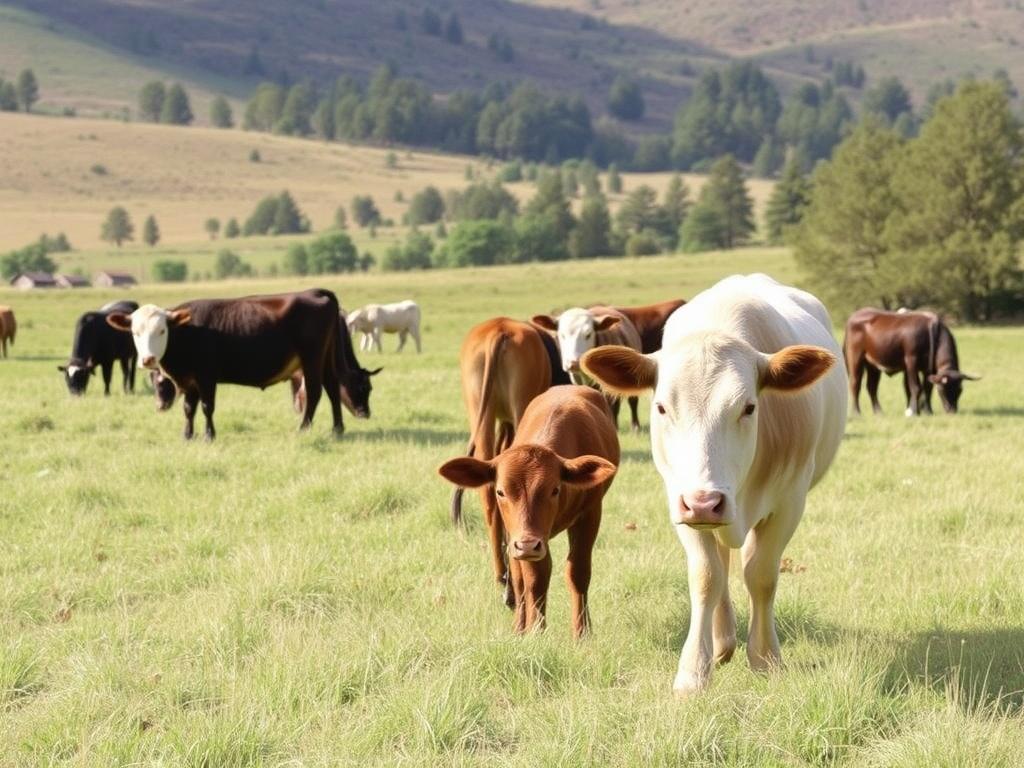
Choosing the Right Livestock Breed for Your Farm’s Goals is a decision that shapes everything from daily routines to long-term sustainability. It’s not merely about what looks pretty in the pasture or what your neighbor raises; breed choice affects feed budgets, labor, veterinary needs, market opportunities, and how your land performs over seasons.
This guide walks through the logic and practical steps that lead to a confident selection. I’ll blend objective criteria, decision tools, and real-world examples so you can match a breed to specific goals—whether that goal is direct-to-consumer meat sales, grass-fed dairy, conservation grazing, or a low-input homestead herd.
Содержание
Start with clear farm goals
No breed can be judged in isolation from what you want your farm to achieve. Do you want high-volume output, premium niche products, ecological restoration, or a low-maintenance herd for supplementary income? Answering that question narrows the field rapidly.
Write a short mission statement for the project: what you will produce, why, and how success will be measured. This statement becomes your touchstone when trade-offs appear—more milk vs. more forage, faster growth vs. hardiness.
Be specific about time horizons. Some breeds offer quick returns, while others pay off through longevity, fertility, or landscape benefits that accumulate over years. Treat the choice like a small business plan rather than a hobby purchase.
Know the broad livestock categories
Before comparing breeds, separate animals by production purpose: meat, milk, fiber, draft, or mixed-use. Each category has different performance metrics and infrastructure needs.
Within those categories you will encounter beef cattle, dairy cattle, sheep for meat, wool or dual-purpose, meat goats vs. fiber goats, laying hens vs. meat birds, and heritage swine versus modern hybrids. Crossbreeding can combine traits, but it also complicates management.
Creating a simple decision matrix helps. Below is a compact comparison to orient your thinking—use it as a quick reference, not a definitive ranking.
Category
Primary product
Typical strengths
Key considerations
Beef cattle
Meat
Carcass size, feed conversion
Pasture availability, finishing system
Dairy cattle
Milk
Milk yield, butterfat/protein
Milking infrastructure, labor
Sheep
Meat, wool
Low input, flocking behavior
Predator control, parasite management
Goats
Meat, milk, fiber
Browsers, adaptable
Fencing, parasite resilience
Pigs
Meat
Fast growth, feed efficiency
Housing, waste management
Poultry
Eggs, meat
Quick turnover, low space
Biosecurity, predators
Define measurable selection criteria
Once you know the category, translate your goals into objective traits. Measurable criteria keep emotions out of decisions and let you compare breeds empirically. Common criteria include growth rate, reproductive performance, feed efficiency, milk components, and disease resistance.
Ask, “What does success look like in numbers?” For a meat enterprise that might be average daily gain, dress-out percentage, and time to market weight. For dairy, it might be pounds of milk per lactation and component percentages that influence cheese yield.
Rank the traits by importance. This ranking clarifies trade-offs: choosing higher fertility might mean sacrificing maximum growth rate, or choosing hardiness might lower peak production but reduce veterinary bills.
Productivity traits
Productivity is often the first filter—how much animal product per unit of input. Look at weaning weights, milk yield, fleece weight, or egg production depending on your enterprise. Use breed averages from extension services or breed associations as baseline numbers.
Remember that productivity data comes from different production systems. A breed averaged on a high-input commercial farm may perform differently on your low-input pastures. Seek data from similar systems when possible.
Adaptability and climate resilience
Adaptability covers heat tolerance, cold hardiness, parasite resistance, and ability to forage on available plants. A high-producing breed from a temperate zone can falter in hot, humid conditions, costing you more on feed and medicine than a lower-producing but adapted breed.
Local experience matters. Talk to farmers in your microclimate and observe how breeds perform through seasons. Sometimes a breed’s reputation for “hardiness” is actually a reflection of proper management rather than innate resilience—distinguish the two.
Temperament and handling
Calm, curious animals are easier and safer to handle, which lowers labor costs and stress-related production losses. Temperament matters for small crews and new farmers more than for large-scale operations that rely on heavy handling infrastructure.
Breed temperament often has a genetic basis but is shaped by early handling. If you plan frequent close contact—milking, family visits, agritourism—choose breeds with a track record of docility.
Reproductive performance and longevity
Fertility, calving ease, lambing percentage, and litter size influence stocking rates and cash flow. Longevity reduces replacement costs and stabilizes genetic progress. Breeds with higher lifetime productivity can be more profitable despite lower peak performance.
Prioritize traits that reduce risk. For example, a cow breed with fewer dystocia problems might be more suitable for a one-person operation than a high-milk breed prone to calving difficulty.
Match breed characteristics to your environment
Soil, forage species, rainfall patterns, and seasonal temperature swings all shape what a breed can realistically deliver on your land. Matching animals to the environment is as critical as matching them to the market.
If your pasture has diverse brush and woody species, consider goats or browsing sheep breeds that utilize that forage niche. If you have abundant cool-season grasses, cattle breeds that convert grass to weight efficiently become attractive.
Also consider water availability. Some breeds drink more or have higher metabolic heat production and thus increased water needs. Map your water sources before committing to a high-demand breed.
Consider infrastructure and labor
Breeds vary in the facilities they require. Dairy cows need milking parlors or parlors-on-wheels; pigs require secure barns for farrowing; poultry needs predator-proof housing and frequent cleaning. These capital investments must align with your budget and timeline.
Labor is another limiter. High-producing animals often demand more hands-on management—frequent milking, more intensive feeding, or closer health monitoring. If your labor pool is small, prioritize lower-maintenance breeds.
Think about handling equipment too. Some breeds tolerate simple handling systems, while others may necessitate heavy-duty chute work and loading ramps for safe, efficient movement.
Crunch the numbers: costs, returns, and risks
A breed’s profitability is the result of many moving parts: feed costs, veterinary bills, labor, mortality, and market price for the product. Run conservative financial scenarios before purchasing stock.
Include fixed and variable costs in your calculations. Fixed costs are fencing and shelter; variable costs include feed, veterinary care, and bedding. Compare several breeds using the same assumptions to reveal relative economic performance.
Here’s a short checklist to build a basic budget model:
Estimate average production per head per year (milk, weight gain, eggs).
Calculate feed required to achieve that production under your pasture and feeding plan.
Estimate health and breeding costs per head.
Factor in replacement rate and mortality assumptions.
Project market price volatility and set break-even prices.
Understand genetics, selection, and health
Genetics provides the long-term lever for improving performance. Start with reputable breeders and documented pedigrees when possible. Traits like disease resistance, growth, and fertility often have measurable heritability.
Avoid buying from unknown sources that mix animals without health certification. Introducing new animals without quarantine and testing invites disease and genetic problems into your herd or flock.
Use selection indexes if available for your species; they combine multiple traits into a single score tailored for production systems. Work with extension agents or breed association resources to interpret these indexes.
Biosecurity basics
Set up a quarantine area to hold new animals for at least 21 days, monitor for illness, and run recommended tests. Keep records of vaccinations, treatments, and reproductive history. Small lapses in biosecurity can cost far more than selecting a cheaper animal initially.
Train everyone on your farm to follow biosecurity protocols. Clean boots, disinfect equipment, and controlled visitor access reduce risk. If you plan to buy genetics (semen, embryos), use certified sources and follow storage protocols.
Working with a veterinarian and extension services
Partner with a veterinarian experienced in your species early on. A good vet helps design vaccination programs, reproductive plans, and herd health strategies that align with the breed’s known weaknesses.
Extension agents and breed associations have localized knowledge about performance under regional conditions. They often provide trial data, demonstration farms, and breed comparisons that are invaluable for objective decision making.
Animal welfare, behavior, and handling systems
Welfare influences productivity, reputation, and legal compliance. Some breeds handle stress better, which matters if you plan to move animals frequently, participate in shows, or offer farm visits. Behavioral traits affect fencing needs and predator vulnerability.
Design handling systems to match the animals you choose. Quiet alleys, low-stress restraint, and thoughtful facility layouts reduce injuries and speed up routine operations. Investing in good handling infrastructure usually pays back in worker safety and bigger animal gains.
Observe animals regularly. Early detection of lameness, parasites, or social stress prevents small issues from becoming herd-level problems.
Market channels and product specifications
Where you sell dictates what you should raise. Farmers who sell directly to consumers or restaurants can often command premiums for heritage breeds or pasture-raised claims. Commodity markets favor standardized, high-yield animals.
Research buyer specifications in advance. A butcher or processor may prefer particular carcass weights or fat distribution. For dairy, cheesemakers often need certain fat and protein percentages to make their products economically viable.
If you want to brand around breed—say, a rare sheep for specialty wool—ensure there is a willing audience. Branding can justify slower-growing or lower-yield breeds if consumers value the story and quality.
Practical testing: start small and monitor
Never commit your entire operation to an unproven breed. Run a pilot cohort to observe real-world performance under your management. A dozen animals often reveals far more than theoretical data or one-off farm visits.
During the test, track key metrics: growth rates, reproduction, feed intake, health events, and labor time. Compare these to your expected benchmarks and to any other breeds on the farm if you have them.
Be prepared to adapt. If a breed underperforms in your systems despite best practices, it’s not failure—it’s information. Use test outcomes to refine your selection or management rather than to stubbornly persist with the original plan.
Step-by-step pilot plan
Set clear measurable goals for the pilot (e.g., 1.8 lb daily gain or 60% kidding rate).
Purchase a small, representative sample from reputable sources.
Quarantine and implement a consistent management protocol.
Collect data weekly and compare to benchmarks.
Review results after one production cycle and decide whether to scale, modify, or change breeds.
Running pilots also builds your confidence and creates replicable protocols for future animal introductions. Keep meticulous records so your next decision is stronger than the last one.
Real-life examples and lessons learned
On a small mixed farm I worked with, the owner switched from a high-yield dairy breed to a dual-purpose heritage breed. The heritage animals produced less milk, but their richer components and calmer temperament allowed the farmer to pivot into artisan cheese and agritourism. Revenue per animal rose despite lower liters of milk.
Another friend ran a grass-fed beef operation in rolling, rocky terrain. He initially picked a large continental beef breed for their marbling, only to find feed conversion poor on pasture alone. Switching to a smaller British beef breed improved average daily gains on pasture and reduced supplemental feeding costs, increasing margins.
These examples highlight two points: first, product-market fit can outweigh raw production numbers; second, a breed that excels on one farm might not on another. Local testing and flexible business models are powerful allies.
Breed resources and how to research responsibly
Breed associations publish performance data, but interpret it cautiously. Ask for data from farms with similar management intensity and climate. University extension publications often provide impartial, region-specific comparisons and are a good place to start.
Attend breed field days, fairs, and producer meetings. Seeing animals on different farms and talking to multiple breeders gives you a feel for temperament, handling needs, and typical health challenges. When possible, ask to see records, not just anecdotes.
Online forums can be helpful but filter the noise. Look for posts backed by data or that come from experienced producers. Beware of confirmation bias—if everyone on a forum claims one breed is perfect, dig deeper to understand the context.
Breeding strategies: purebred, crossbred, and composite
Purebreds offer predictability and breed-specific markets, but they may lack hybrid vigor. Crossbreeding can improve fertility, growth, and survivability through heterosis, which is especially valuable in low-input systems. Composite breeds attempt to lock in hybrid vigor across generations.
Consider terminal and maternal cross strategies in meat systems. Use robust maternal breeds for breeding stock and terminal sires to maximize market weight and carcass traits in offspring destined for slaughter. This strategy requires careful record-keeping and planning.
Whatever you choose, maintain clear records of pedigrees, performance, and management. Genetic progress is real but slow—consistent selection and culling practices over multiple generations deliver the best results.
Common pitfalls to avoid
Buying attractive animals without checking health history or performance under similar conditions is a frequent error. Pay attention to documented metrics and verify seller claims when possible.
Another mistake is underestimating predator pressure, parasites, or seasonal feed shortfalls. A breed that thrives in one region can struggle disastrously in another if those pressures differ significantly.
Finally, plan for succession and knowledge transfer. The best breed choice can be undermined if future caretakers lack the time, skill, or inclination to manage it properly.
Actionable next steps for your farm
Start by drafting your mission statement: product, market, timeline, and success metrics. That clarity will guide the rest of your decisions. Use the selection criteria in this article to build a short list of three breeds to evaluate further.
Schedule farm visits and interviews with breeders and extension agents. Run a budget scenario for each breed under realistic assumptions, and plan a small pilot to confirm performance. Quarantine, test, and monitor closely when introducing animals.
Finally, keep flexible. As you gather real data from your own land and animals, your strategy may shift. Treat breed choice as a strategic decision that evolves with experience rather than a one-time commitment.
Choosing the right livestock breed is a blend of clear goals, honest evaluation of your land and resources, and careful testing. When you align breed traits with your objectives—and remain willing to iterate—you build a resilient, productive farm that fits both your landscape and your livelihood.